
Published on Jan 22, 2026
SOC Analyst Roadmap: The Complete Guide to Becoming a Cybersecurity Analyst
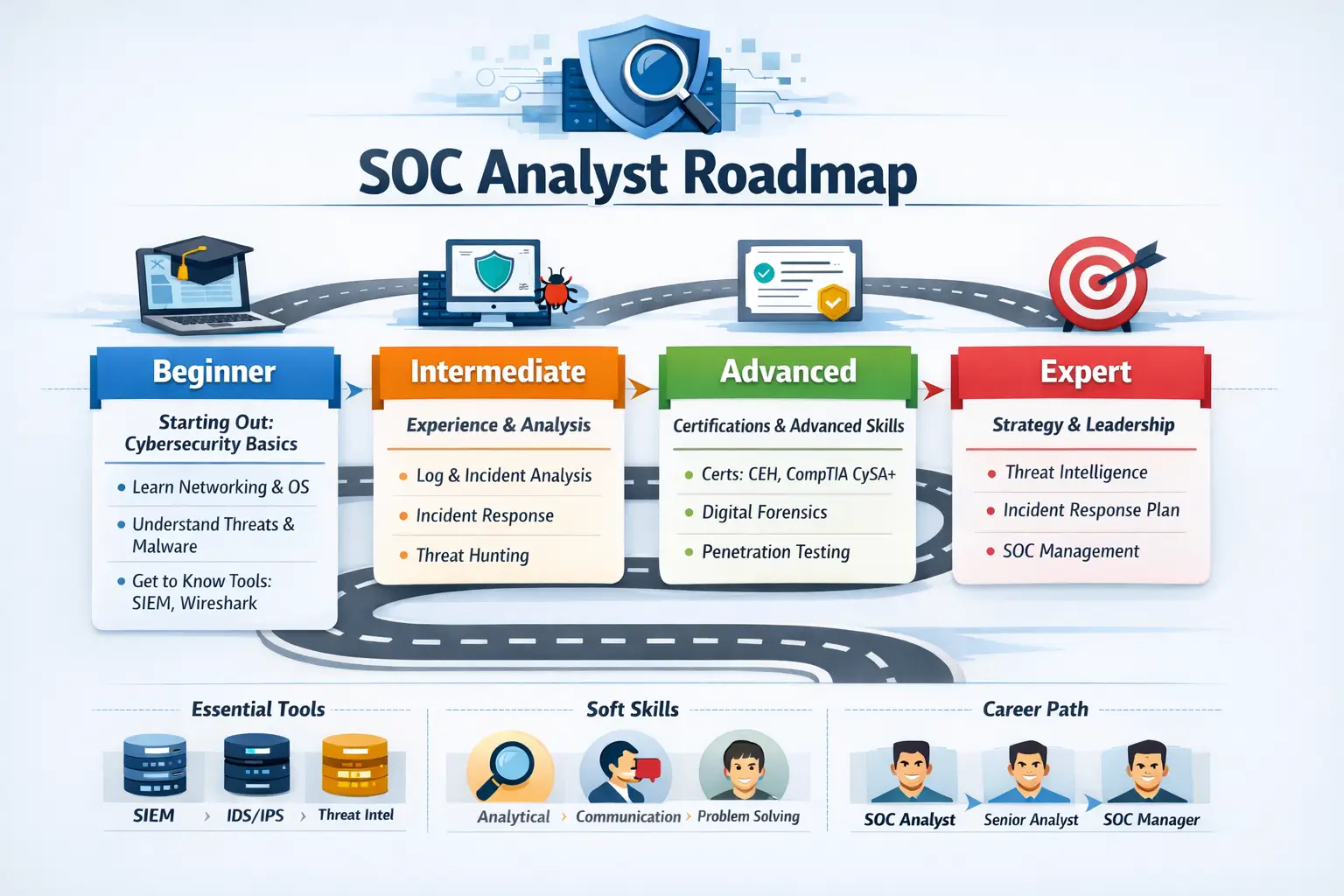
In today’s digital era, cyberattacks are increasingly sophisticated and widespread. Companies, government agencies, and even technology startups require dedicated teams tasked with monitoring, detecting, and responding to security threats. This is where the role of the SOC Analyst (Security Operations Center Analyst) becomes crucial.
SOC Analysts are at the forefront of cybersecurity defense. This profession is suitable for those interested in IT, network security, and incident analysis. This article will discuss the SOC Analyst Roadmap in detail, from basic understanding, required skills, necessary tools, and career paths. The writing is written in easy-to-understand language and is beginner-friendly.
What is a SOC Analyst?
A SOC Analyst is a cybersecurity professional who works within a Security Operations Center (SOC). Their primary responsibility is to monitor systems, networks, and applications to detect suspicious activity or cyberattacks.
In general, a SOC Analyst is responsible for:
- Monitoring security logs and alerts
- Analyzing potential threats
- Handling and responding to security incidents
- Reporting incidents and making mitigation recommendations
- Collaborating with other IT and security teams
SOC Analysts typically work shifts because security monitoring is conducted 24/7.
SOC Analyst Levels
In practice, SOC Analysts are divided into several levels based on their responsibilities and task complexity:
1. SOC Analyst Level 1 (Tier 1)
This is the entry-level position. The primary focus is on monitoring and triaging alerts.
- Monitoring SIEM dashboards
- Filtering false positives
- Escalating incidents to higher levels
2. SOC Analyst Level 2 (Tier 2)
Tasked for deeper incident analysis.
- Investigating network logs and traffic
- Performing basic malware analysis
- Providing mitigation recommendations
3. SOC Analyst Level 3 (Tier 3)
Advanced and specialized level.
- Threat hunting
- Digital forensic analysis
- Complex incident handling
- SIEM use case and rule development
SOC Analyst Roadmap
Here is a step-by-step roadmap to becoming a professional SOC Analyst.
1. IT and Networking Basics
Before entering the world of SOC, you must understand the fundamentals of IT.
Required skills:
- Networking concepts (TCP/IP, DNS, HTTP/HTTPS)
- Operating systems (Linux and Windows)
- Server and virtualization fundamentals
- Basic cloud computing concepts
Understanding networking is crucial because most attacks occur through networks.
2. Cybersecurity Basics
After understanding basic IT, the next step is to learn the fundamentals of cybersecurity.
Important material:
- CIA Triad (Confidentiality, Integrity, Availability)
- Types of attacks (phishing, malware, DDoS, brute force)
- Firewall and IDS/IPS concepts
- Security risk management
At this stage, focus on understanding how attacks work and how to prevent them.
3. Log Management and Monitoring
SOC Analysts rely heavily on logs.
What you need to learn:
- Types of logs (system logs, application logs, security logs)
- How to read and analyze logs
- The concept of alerts and correlation
The ability to read logs quickly and accurately is key for a SOC Analyst.
4. SIEM (Security Information and Event Management)
SIEM is a core tool in a SOC.
Examples of popular SIEMs:
- Splunk
- IBM QRadar
- Elastic SIEM
- Microsoft Sentinel
Essential skills:
- Creating and understanding rules
- Alert analysis
- Dashboard monitoring
- Incident correlation
You don’t need to master all SIEMs; just focus on one or two first.
5. Incident Response and Threat Analysis
At this stage, you learn how to respond to incidents.
Materials you need to master:
- Incident Response Lifecycle
- Root cause analysis
- Containment and eradication techniques
- Basic threat intelligence
A SOC Analyst not only detects but also helps minimize the impact of attacks.
6. Basic Malware and Forensics
For intermediate and advanced levels, an understanding of malware and forensics is very helpful.
What to learn:
- Malware types (viruses, trojans, ransomware)
- Basic static and dynamic malware analysis
- Digital forensics (log, memory, disk)
These skills are typically required at SOC Analyst Levels 2 and 3.
Tools a SOC Analyst Must Master
Here are some essential tools:
- SIEM (Splunk, QRadar, Elastic)
- Endpoint Detection & Response (EDR)
- Firewall and IDS/IPS
- Ticketing system (Jira, ServiceNow)
- Threat intelligence platform
You don’t need to master everything right away; learn gradually as needed.
Certifications for SOC Analysts
Certification can increase credibility and job opportunities.
Popular certifications:
- CompTIA Security+
- Blue Team Level 1 (BTL1)
- CEH (Certified Ethical Hacker)
- SC-200 (Microsoft Security Analyst)
Choose a certification that suits your level and career goals.
Soft Skills That Shouldn’t Be Ignored
Besides technical skills, soft skills are also very important.
- Analytical skills
- Clear communication
- Stress management
- Teamwork
- Documentation and reporting
SOC Analysts often work under pressure, especially when major incidents occur.
SOC Analyst Career Paths
SOC Analysts can develop into various career paths:
- Senior SOC Analyst
- Incident Responder
- Threat Hunter
- Cyber Security Engineer
- Security Architect
- SOC Manager
With the right experience and skills, career opportunities in this field are vast.
Tips for Starting a SOC Analyst Career
- Build your own lab (home lab)
- Participate in training and CTFs
- Be active in the cybersecurity community
- Increase real-world case studies
- Consistently learn and stay updated on attack trends
Conclusion
SOC Analyst is a challenging yet promising profession in the world of cybersecurity. With a clear roadmap, gradual learning, and consistency, anyone can start a career in this field, even from scratch.
Hopefully, this SOC Analyst Roadmap article helps you understand the steps you need to take. If you’re serious about pursuing cybersecurity, SOC Analyst can be a very solid entry point to a professional career in cybersecurity.
Also Read

Mass Authentication: Definition, How It Works, and Its Role in the Digital Age
In today’s digital era, the number of users accessing a system can reach thousands or even millions simultaneously. These include e-learning platforms, …
Best AntiVirus for Mac: Top Recommendations for Maximum Security
Many Mac users still believe that macOS is immune to viruses and malware. In fact, even though macOS has a fairly robust built-in security system, cyber threats …

CVE-2025-55182: Full Description, Impact, and Mitigation
The world of cybersecurity is never truly calm. Almost every year, new security vulnerabilities emerge that have the potential to be exploited by malicious …

Windows Vulnerabilities via Kernel Drivers and Named Pipes Allows Privilege Escalation
Windows operating system security is a perennial topic, especially when discussing vulnerabilities that attackers can exploit to gain elevated access rights. …

Google Maps Adds Feature for Businesses to Report Ransom Demands Through Reviews
Google Maps is now introducing a new feature aimed at protecting businesses from digital extortion practices perpetrated through reviews. This step comes in …